Souvenir guide · Travel money
ATM fees abroad: what you actually pay, and how to pay less
One withdrawal can carry up to four separate costs, from two different companies. What each one is, where it shows up, and what you can do about it.

Four costs, two companies
The amount you withdraw is not the amount you pay. Up to four charges can come with it, and they come from two places: the company that owns the machine, and the bank that issued your card.
1. The ATM operator’s fee
The bank or company that runs the machine may charge for using it. It is usually shown on the screen before you confirm and printed on the receipt, and it is taken in the local currency, on top of the cash. Not every machine charges one, and fees can differ between machines in the same street. If you don’t like the number on the screen, cancel and try another bank’s machine.
2. Your bank’s foreign ATM fee
Your own bank may charge for a withdrawal at another bank’s machine abroad: a flat amount, a percentage, or both. You won’t see it at the machine. It appears on your statement, and the terms are in your account’s fee schedule. Some accounts charge nothing; some refund other operators’ fees too.
3. The foreign transaction fee
Many cards add a percentage to any transaction in a foreign currency, cash or purchase. Card terms call it a foreign transaction fee, a non-sterling transaction fee, a currency conversion fee or a foreign exchange fee. Because it applies to card payments as well, it is part of the cost of everything you buy abroad, not only cash. Sometimes it is a separate line on the statement; sometimes it is folded into the converted amount.
4. The exchange rate
Someone has to turn the local currency into yours. If you let your card do it, your card network converts at its rate for that day. Many ATMs and card terminals abroad also offer to do the conversion themselves and charge you in your home currency, often worded as a choice “with conversion” or “without conversion”. That service is called dynamic currency conversion, and it uses the machine operator’s own rate, which can include a markup.
In the European Union, the provider has to show its conversion charge as a percentage markup over the European Central Bank’s reference rate before you accept. Elsewhere, the screen may show only a final amount. Either way, the safer default is to choose the local currency and let your card convert.
A worked example
The numbers below are made up for the arithmetic. Your fees are in your own bank’s terms.
You live in the United States and withdraw €200. The machine shows a €3 fee. Your card network’s rate that day is 1 EUR = 1.10 USD, your card charges a 2% foreign transaction fee, and your bank charges $5 for a foreign ATM withdrawal.
- Cash in your hand€200worth $220.00 at 1.10.
- Operator’s fee€3debited with the cash: €203 × 1.10 = $223.30.
- Foreign transaction fee$4.472% of $223.30.
- Your bank’s ATM fee$5.00a flat fee per withdrawal.
Now suppose the machine offers to charge you in dollars: $231.00 for the €203. That works out at 1 EUR = 1.138 USD, about 3.4% worse than the network’s 1.10, or $7.70 more than the $223.30. Depending on your card’s terms, the foreign transaction fee may still apply as well, because the machine is abroad.
How to pay less
Before you leave
- Read your card’s fee schedule. Look for the foreign ATM fee, the foreign transaction fee, and whether other operators’ fees are refunded. Some cards and accounts charge none of these; it is worth knowing which of yours do before you pick the one to travel with.
- Carry a second card, ideally on a different network, in case a machine refuses the first one or a card is blocked.
- Withdraw with a debit card. On many credit cards, cash from an ATM is a cash advance, with its own fee and interest from the day you take it. Check your card’s terms before relying on one.
At the machine
- Read the fee screen and cancel if the fee is more than you want to pay. Another machine may charge less, or nothing.
- Decline the conversion. Choose to be charged in the local currency, at ATMs and card terminals alike.
- Keep the receipt until the withdrawal shows on your statement, so you can tell the operator’s fee from your bank’s.
How often
Flat fees are paid per withdrawal, so fewer, larger withdrawals pay them fewer times. In the example, one withdrawal of €400 instead of two of €200 saves one set of flat fees: about $8.30 (the €3 at 1.10, plus the $5). Percentage fees cost the same either way. Weigh the saving against carrying more cash, the machine’s and your bank’s daily limits, and the cost of changing leftover notes back at the end.
Record the fees apart from your spending
A withdrawal is not spending: it moves money from your bank into your pocket. What you buy with the cash, and the fees for getting it, are the trip’s costs. Recording the €200 as spending and then the lunch you pay with it counts the same money twice. How to track cash, ATM withdrawals and exchange fees shows the method, with one balance per currency.
Kept apart, the fees add up to a number worth knowing: what cash actually costs you on this trip. If it is high, change the habit: use fewer withdrawals, another machine, or a card. Then cover it in your budget’s margin; the travel budget calculator adds that margin on top of daily spending.
Let the app keep the banks’ cut
Souvenir records cash the way this guide describes, on iPhone and Android:
- An ATM withdrawal fills a cash pocket, one per currency, instead of counting as spending. Cash purchases drain the pocket.
- The fee goes on the same withdrawal and is the only part that counts as spending. “The banks’ cut” adds up every ATM and card fee on the trip.
- Each expense keeps the rate for the day you spent, so the home-currency value doesn’t shift later.
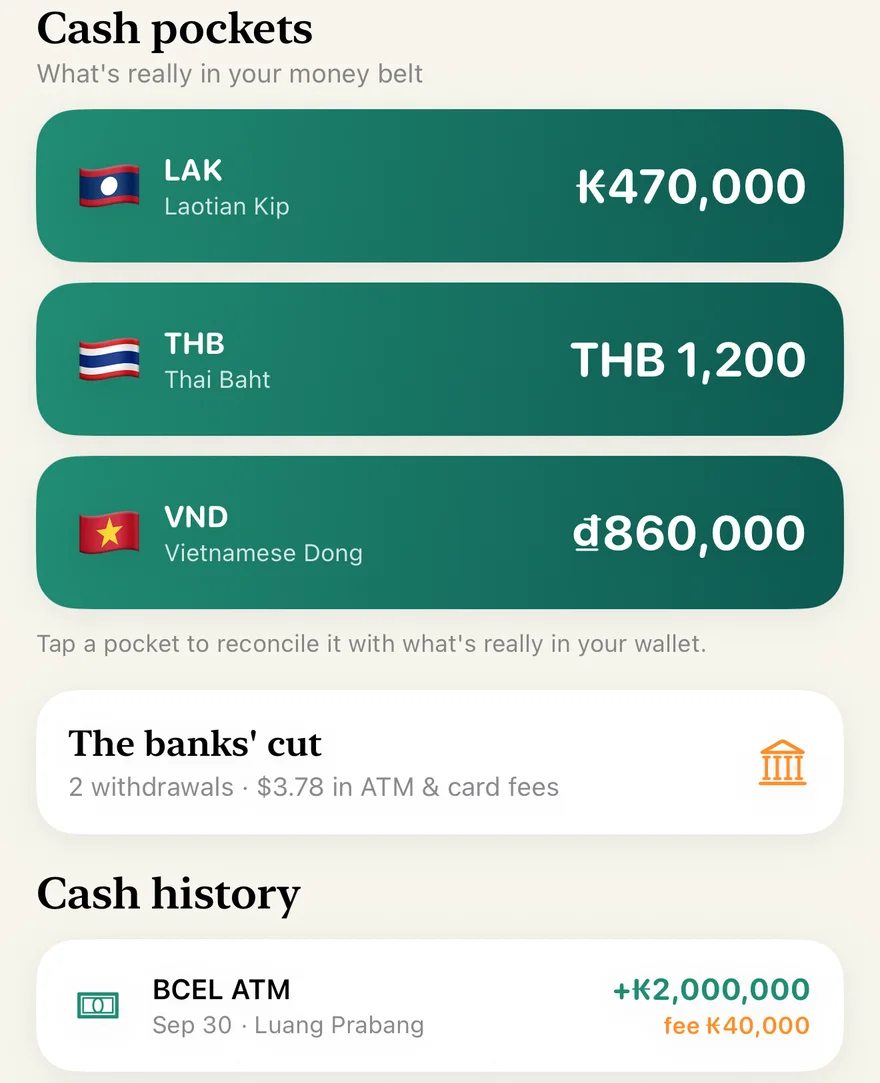
Souvenir is free on the App Store for iPhone (iOS 26 or later) and on Google Play for Android 8 and later. Logging works offline; an exchange rate the phone hasn’t stored yet needs a connection.
ATM fee questions
Should I let a foreign ATM charge me in my home currency?
Usually not. Choosing the local currency lets your card network do the conversion. Accepting the machine’s offer means its operator converts at a rate it sets, which can include a markup. If the screen shows its rate, compare it with a reference rate before you accept.
Why did my bank take more than the ATM showed?
The fee on the ATM screen is only the machine operator’s. Your own bank’s foreign ATM fee and any foreign transaction fee are added by your bank and appear on your statement later, sometimes folded into the converted amount.
Is it cheaper to take out more cash at once?
For flat fees, yes: one withdrawal of 400 pays the per-withdrawal fees once instead of twice. Percentage fees cost the same either way. Weigh the saving against carrying more cash, the machine’s and your bank’s limits, and changing leftover cash back at the end.
Do ATM fees count as travel spending?
The fees do; the withdrawal does not. Taking out cash only moves money from your bank into your pocket. What you buy with it, and the fees for getting it, are the trip’s costs.
Use the method
Try it with Souvenir
Log travel expenses in any currency at that day’s rate, track ATM cash in cash pockets, split with friends, settle up in fewer payments, keep the journey.
See everything Souvenir does →