Souvenir guide · Trip budget
How to set a daily travel budget, and keep it true as the trip goes
Two honest ways to a daily number, what to leave out of it, and how to keep it useful when the trip stops following the plan.

Decide what the daily number is for
A daily budget answers one question while you are travelling: can I afford this today? It should therefore hold only what you decide on day by day: food and drink, local transport, activities and entry fees, small things like laundry or a SIM card, and accommodation if you pay for it as you go.
Everything else is still part of the trip’s cost. It just isn’t a decision you make at a market stall, so it doesn’t belong in the number you check there.
Take prepaid costs out first
Flights, travel insurance, rail passes, tours and stays paid in advance are real costs, often the largest ones. Count them in the trip total and leave them out of the daily allowance.
Take a made-up example: a 14-day trip with a total budget of $3,000, of which $900 went on flights and insurance before leaving. The money for the trip itself is $2,100, and that is the number to divide, not $3,000. Dividing the full total would promise $214 a day that doesn’t exist.
Two ways to the number
From what you can afford
Divide the on-trip money by the days: $2,100 over 14 days is $150 a day. That is the top-down number, and it is the right place to start when the total is fixed by what you have.
From what a day costs
Price one ordinary day where you are going, in the local currency:
- a bed for the night, if not prepaid;
- three meals and something to drink;
- getting around: a metro pass, buses, the odd taxi;
- one paid thing: a museum, a tour, a park entry;
- small things: water, tips where expected, laundry.
Use current prices from the source rather than someone’s old trip report: listings on accommodation sites for your dates, menus restaurants post themselves, the fare pages of the local transport operator, and the ticket page of the place you want to visit. Prices change, and a five-year-old blog post is a poor guide to this year.
Use both
If the day you priced costs more than the top-down number allows, change the plan before you leave rather than on day nine: fewer days, a cheaper bed, one city fewer, or a bigger total. If it costs less, the difference becomes your margin.
Convert at the rate you will actually get
A published reference rate is a fair benchmark, but it is not quite what you pay. Card payments abroad may carry a foreign transaction fee, and cash comes with ATM fees on top. ATM fees abroad explains what each of those is.
Either type a slightly worse rate than the reference, or leave the rate as it is and cover the fees with the margin. Keep both currencies in view: prices on the menu are in the local one, but the money you will miss is in yours.
Keep a margin, and decide what it is for
A trip always has costs nobody planned: a missed bus, a pharmacy, a rainy day spent indoors somewhere that charges entry. Keep a margin on top of daily spending for those and for fees, as a percentage you choose. There is no right percentage; there is only one you wrote down.
With a 10% margin, the $2,100 from the example becomes $136.36 a day: $2,100 ÷ (14 × 1.10). The $190.91 that is left over is the margin.
Known one-off costs, like a visa on arrival or a national park permit, are not surprises. Add them to the prepaid costs or the total instead of hoping the margin covers them.
One budget per country, not one average
Price levels can change a lot from one border to the next. Suppose five days in an expensive city at 140 a day (in your home currency), then nine days somewhere cheaper at 70 a day. The trip needs 700 + 630 = 1,330, an average of 95 a day, a number that is wrong in both places. In the city it feels like failure every evening; afterwards it feels like money to burn.
Budget each leg in its own currency, days × daily cost, and add the legs up. The calculator handles one leg at a time; run it once per country.
Judge a week, not a day
Travel days cost little, a day with a tour or a long train ride costs a lot, and arriving somewhere new often costs more than staying put. A single day over the allowance means nothing. Watch the running average over several days and act only if it keeps drifting.
Recalculate when the trip drifts
The plan was made before you knew anything about the trip. Once you are on it, the useful number is no longer the original allowance but this one:
(money for the trip − spent so far) ÷ days to go
In the example, five days in, you have spent $820 of the $2,100. That leaves $1,280 for nine days: $142.22 a day. Spending less than planned raised the allowance; a few expensive days would have lowered it. Either way the plan adds up to the money you actually have. This figure includes the margin, so take the margin off first if you would rather keep it in reserve.
The calculator’s “Already travelling?” fields do this once. A rolling budget in a tracker does it every day.
Couples and groups
Decide whether the budget is per person or shared before you set it. Couples often share one budget; groups of friends usually keep their own and split the shared costs. If one person pays for the group, keep a record of who paid what so nobody is out of pocket at the end. The trip cost splitter works out who owes whom, and how to split group travel expenses covers uneven shares and several currencies.
Keep the budget on your phone
Souvenir works this way as you travel, on iPhone and Android:
- A budget that rolls over. On a trip with dates, each day’s allowance is what is left of the budget divided by the days to go. Underspending raises the coming days, overspending lowers them, never below zero, and the Journey Ledger shows each day against its allowance.
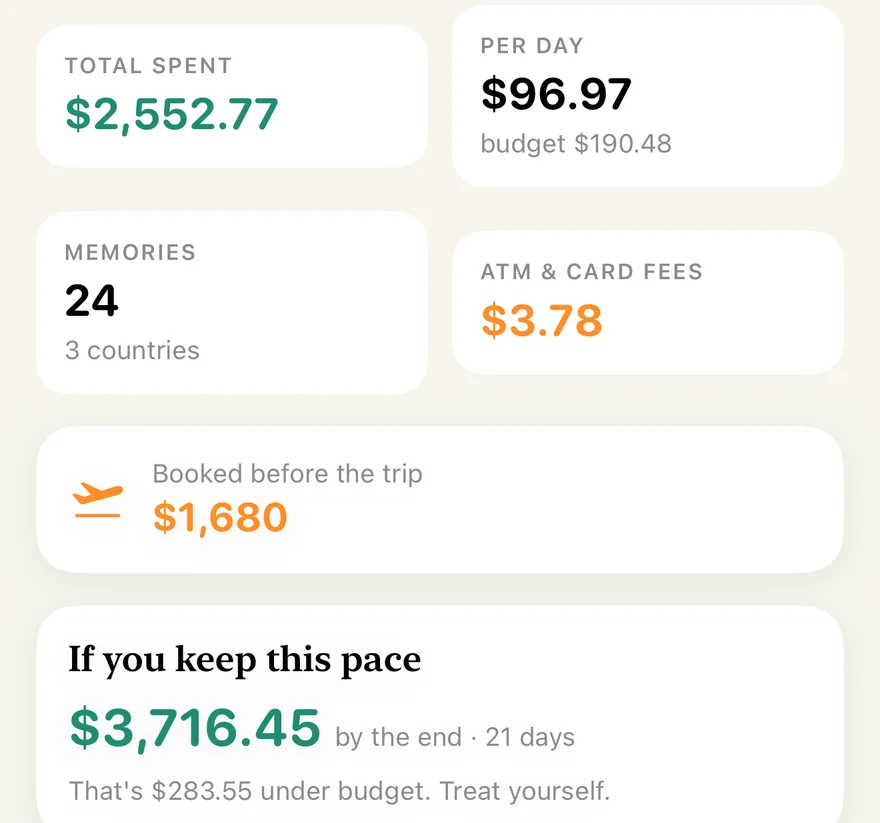
- Prepaid costs kept apart. Mark an expense as booked ahead and it counts in the trip total without making that day look expensive. Stats show the daily pace, the fees and a projection of where the trip ends at that pace.
- The rate for the day you spent. Quick add opens on the amount in the local currency and keeps that day’s rate, so the home-currency figure doesn’t move afterwards.
Souvenir is free on the App Store for iPhone (iOS 26 or later) and on Google Play for Android 8 and later. Logging works offline; an exchange rate the phone hasn’t stored yet, maps and shared-trip syncing need a connection.
Daily budget questions
Should accommodation be part of my daily travel budget?
If you pay for beds as you go, yes: it is usually the biggest daily cost. If you paid for them before the trip, keep them with the other prepaid costs instead, so a prepaid night does not make an ordinary day look expensive. Either way, be consistent for the whole trip.
How big should the margin for fees and surprises be?
There is no universal figure. It depends on how much you pay by card or cash abroad, what your bank charges and how fixed your plans are. Pick a percentage, write it down, track what fees and surprises actually cost on this trip, and adjust it for the next one.
What is a rolling travel budget?
A daily allowance worked out again from what is left: the remaining money divided by the days to go. A cheap day raises the days after it and an expensive day lowers them, so the plan always adds up to the money you actually have.
Do I need a separate budget for each country?
When the price levels differ a lot, yes. Budget each leg in its own currency and add them up. One average across very different countries makes the expensive leg feel over budget every day and the cheap one feel generous.
Use the method
Try it with Souvenir
Log travel expenses in any currency at that day’s rate, track ATM cash in cash pockets, split with friends, settle up in fewer payments, keep the journey.
See everything Souvenir does →